
Larry Rivers/Frank O’Hara - Stones
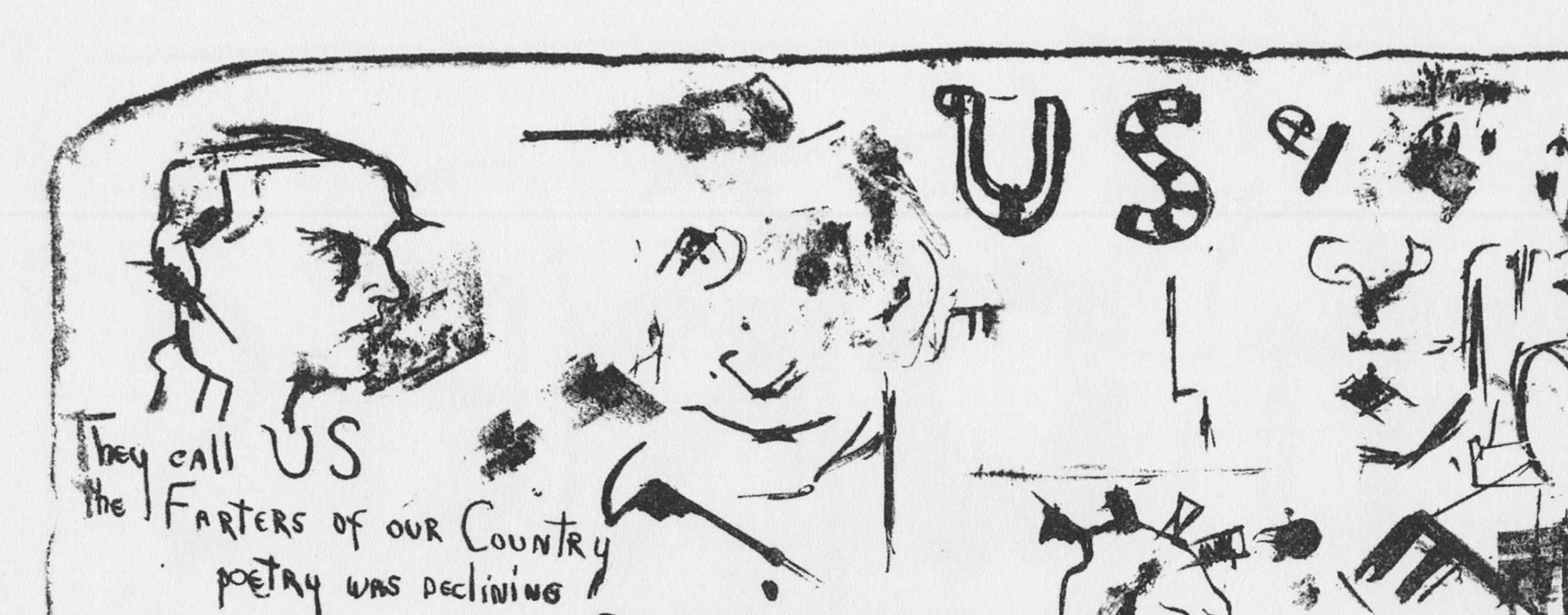
Stones is a collaborative print portfolio made by artist Larry Rivers and poet Frank O’Hara and published by ULAE (Universal Limited Art Editions) in 1959. The complete portfolio contains 13 lithographs (12 image prints and 1 title page).
Rivers and O’Hara were both prominent members of the New York School of Painters and Poets. This informal ensemble group encapsulated a high-water mark for the modernist creative forces working in mid-century New York City. Other prominent members included the poets John Asberry, Kenneth Koch, and James Schuyler. Visual artists in the group included Jane Freilicher, Fairfield Porter, Alfred Leslie, Grace Hartigan, and Michael Goldberg, among others.
Rivers and O’Hara met at a party in John Ashberry’s apartment in 1950, at the very dawn of this movement, and immediately became enmeshed in a bond that oscillated between deep friendship and a fiery intimate relationship. Tatyana Grossman founded ULAE in 1957, which would play a large role in the blossoming of the post-war Print Renaissance in America. It was here that print processes such as American lithography arts moved past their earlier mercantile uses for advertisements, posters and mass-market images for something more refined: art for art’s sake in the modern sense, made by master printers working with emerging artists to created small-run print series that were seen as complimentary to their other paintings, sculptures and drawings.
A central component of Grossman’s artistic vision was to create opportunities for collaboration between artists and writers. In 1957 she approached Rivers with such an idea, and he immediately suggested O’Hara as co-creator.
When ULAE published the Stones portfolio in 1959, it listed the production method as both ‘Tabloscript’ and ‘Lithography’, which is interesting. Lithography is obviously the physical matrix and method that the prints were created with. However, ‘Tabloscript’ was a term invented to describe the creative processes and impulses that informed the interactions used to develop the project as a whole. ULAE credited the coining of the term ‘Tabloscript’ to Barney Rosset.
Rosset was an important member of the New York literary world, and the founder of both the Grove Press and the Evergreen Review, and an early publisher of the Beat Poets. He was also a firebrand who made important contributions to publishing previously banned books, such as Lady Chatterley’s Lover and Tropic Of Cancer. ULAE defined Rosset’s Tabloscript beautifully thus: “Where the artist and the poet inspired by the same theme, draw and write on the same surface at the same time, fusing both arts to an inseparable unity.”
Indeed, the approach taken by Rivers and O’Hara was collaborative in real-time. One would never work on a lithographic stone if the other was not physically present to see what was happening. You could say that the process was the opposite of the ‘Exquisite Corpse’ tradition of Surrealist image-making, where one artist contributes to a drawing without being aware of what the previous artist or artists had already drawn on the page, the whole image’s various components and interactions only being revealed at the end when it was revealed as a singular image.
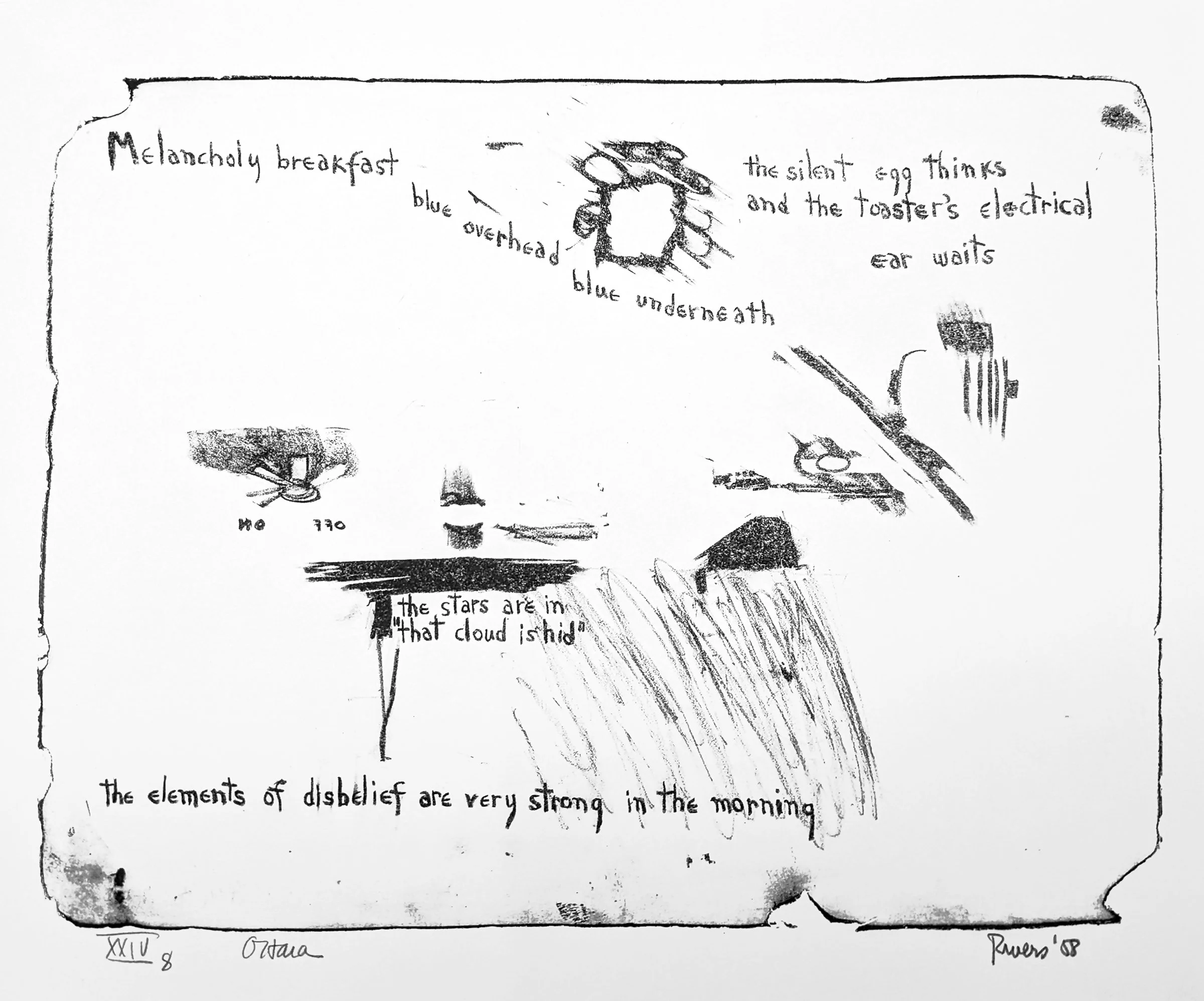
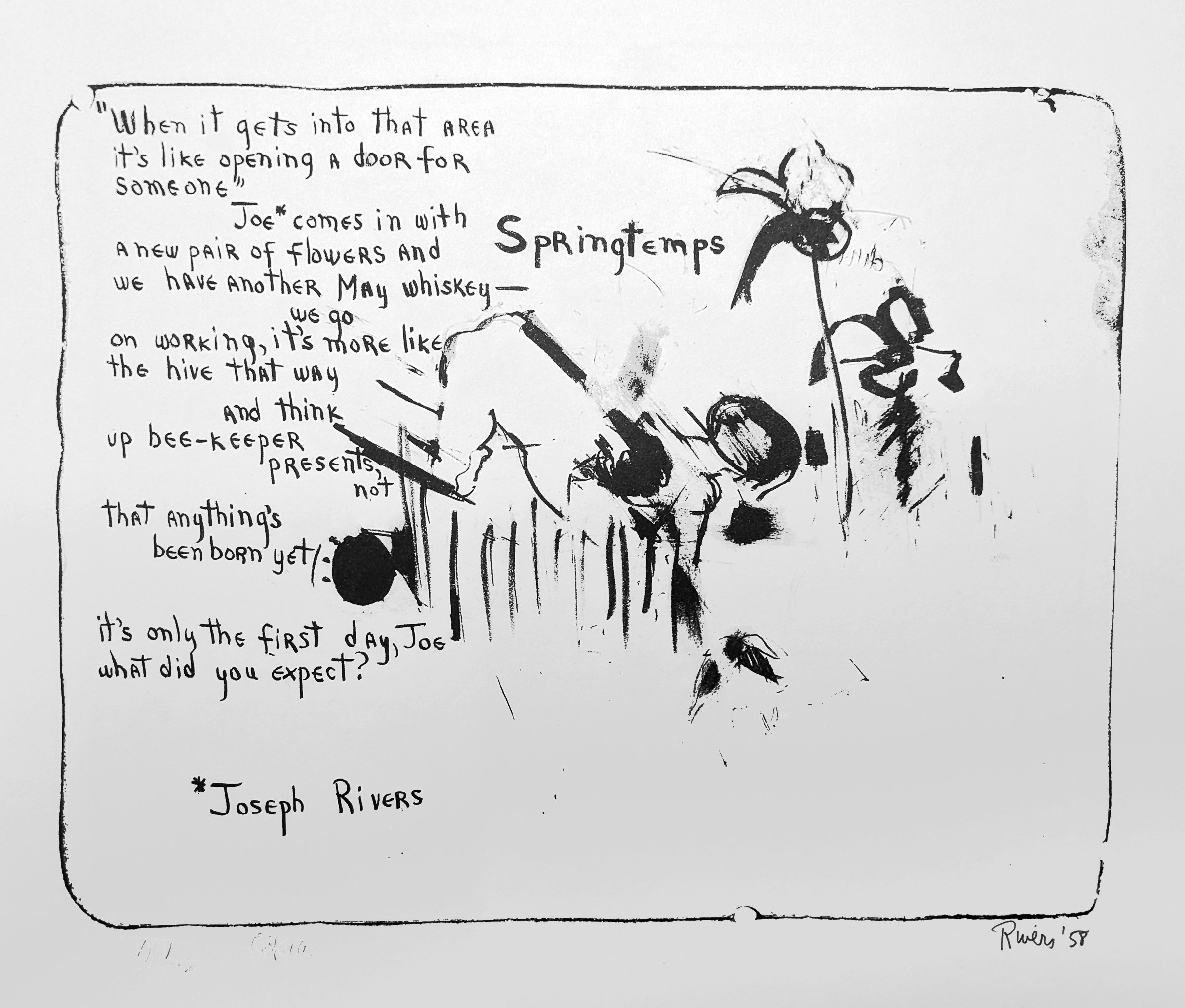
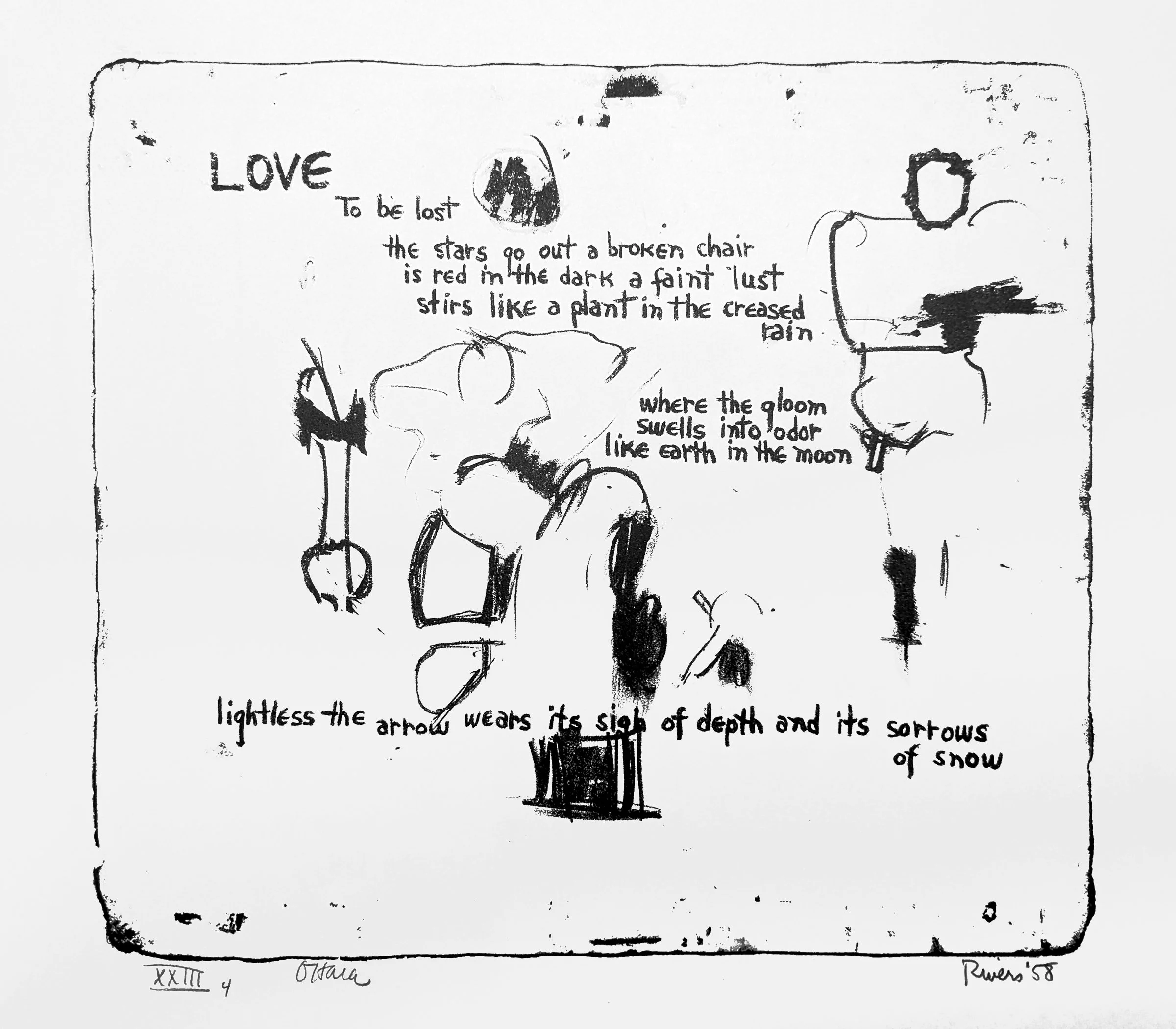
For each print, Rivers or O’Hara would create a small part of a portrait here, or a line of poetry there, to be followed by a mark or gesture there, a flowing thought fragment here. Word and image are truly part of the same thing, they do not sit beside one another, or illustrate each other. They inhabit the same space and moment in time, the way that Einstein merged space and time into the singular, relativistic ‘SpaceTime.”
What letters and lines do not touch remains blank space. Sometimes in art this is referred to as “negative space” or “neutral space”, leaning into the meaning of what is not part of an image but can be seen in conjunction with it. Stones is different. Here the non-marked areas are not Void, but atmosphere, they are the oxygen that lets the gestures and thoughts breathe. This is why each sheet employs a thin-lined rectangular border: inside the border everything is a snapshot of something that was vibrantly alive and summoning itself into existence. Outside the border is the void, a sheet of paper, a signature, a date. Facts, not fulfillment.
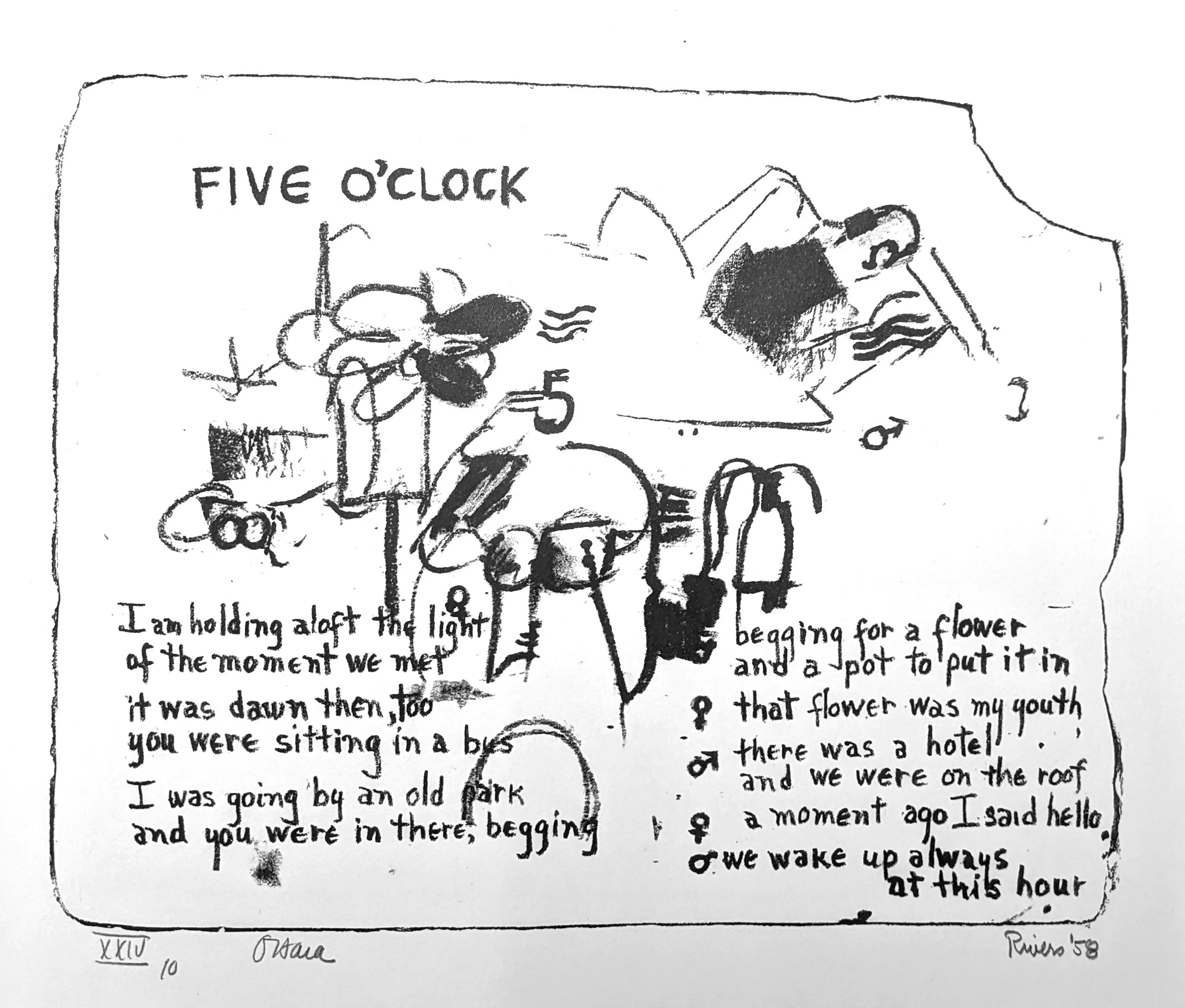
Inside the borders is a fishtank of moments: a quick portrait of O’Hara, a lament about the state of poetry, a part of a flower, “the end of all existences”, a darkened doorway. Faceless, cycladic figurines, “Love, to be lost, the stars go out a broken chair.” Energy, time, and sketch of an artist at work. Art making itself.
Stones is a beautiful example of how art and poetry can best be understood as parts of the same thing, both words and marks creating images and feelings in the mind through the contemplative participation of the viewer. It also perfectly captures my favorite period of American Art History: a brief moment between the beautiful existentialism of Abstract Expressionism and the superficial reality of Pop Art.
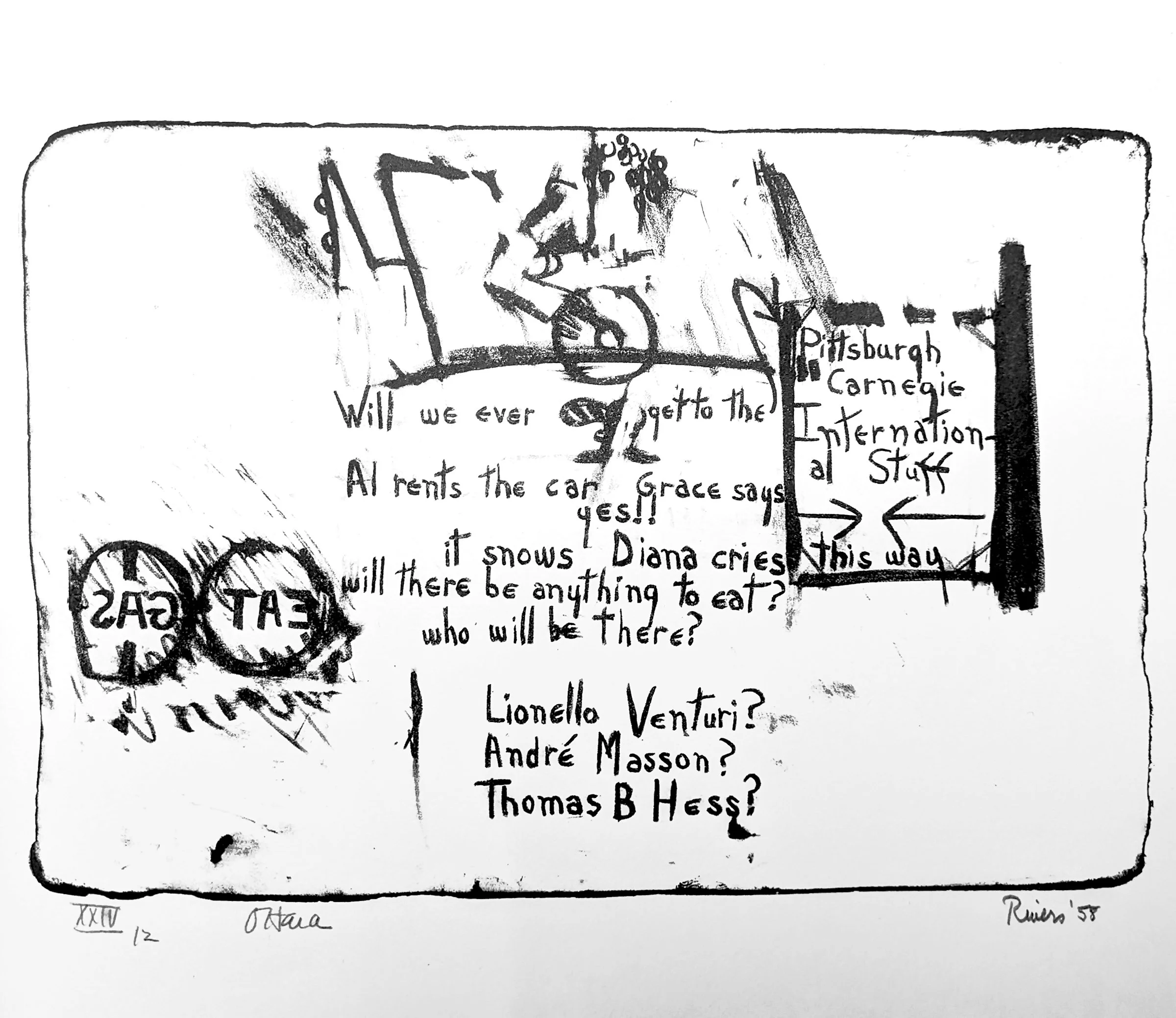
All images displayed for educational purposes only.
Additional Information:
Larry Rivers & Frank O’Hara
Stones, 1957-1959
Portolio of 12 lithographs and title page
19 x 23 1/4 in. / 48.3 x 59.1 cm. each
Edition of 25
Published by ULAE
The images for this article are sourced from the wonderful Stones catalogue published by Tibor de Nagy Gallery as part of that gallery’s 60th Anniversary. You can learn more about it on the Tibor de Nagy Gallery website.
You can also learn more about the portfolio from the website of the edition’s publisher ULAE on their website.